

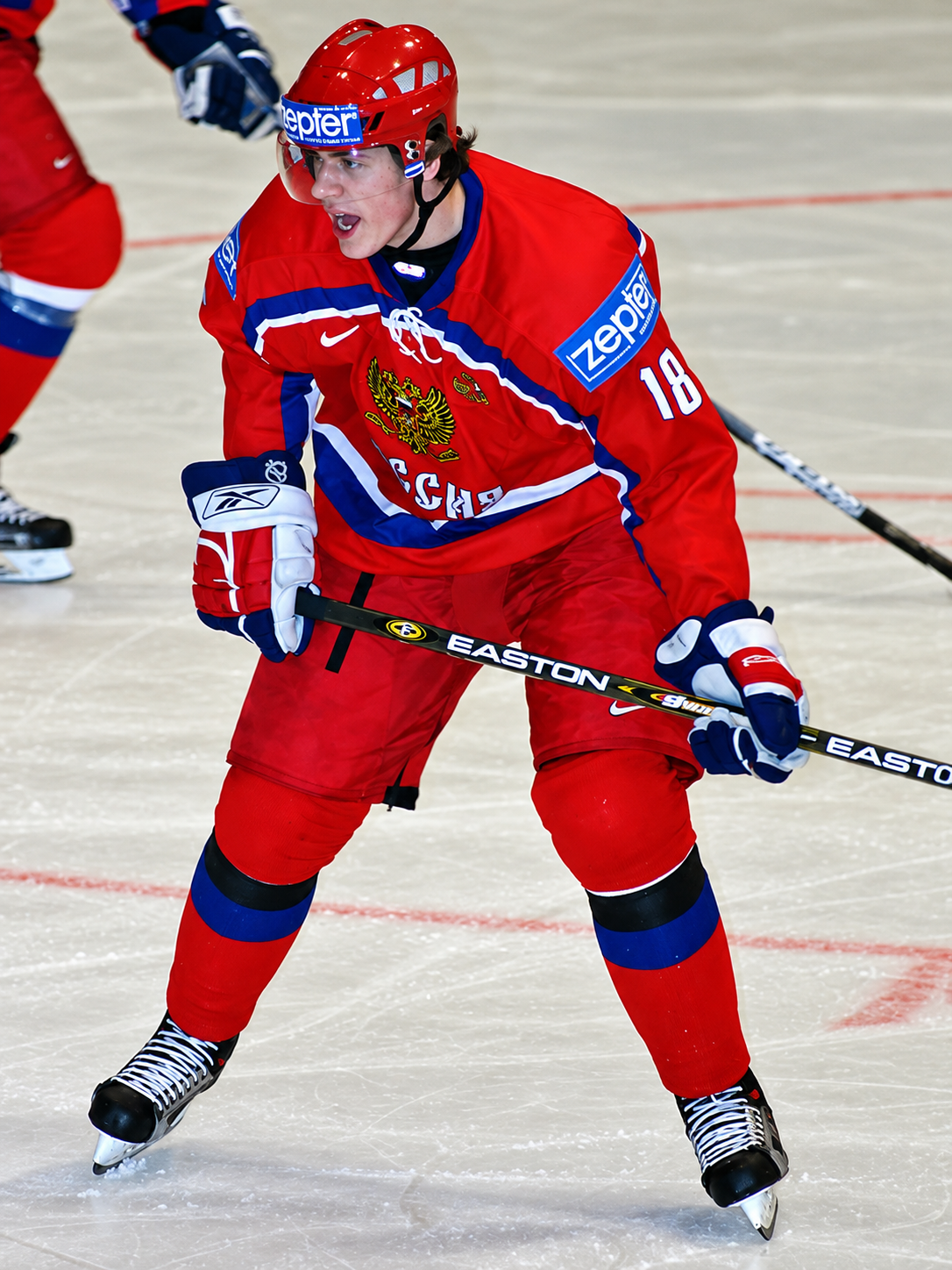
Before He Was "Scor3", He Was A Teenager Facing Defection And All That Comes With It
Pittsburgh Penguins | The Great Escape | 2006–2026
HELSINKI: Before Evgeni Malkin became a three-time Stanley Cup champion, an NHL Most Valuable Player and one of the greatest players in Pittsburgh Penguins history, he was a 20-year-old Russian hockey superstar hiding in Finland, trying to escape a contract that threatened to keep him from his NHL dream.
For five days in August 2006, Malkin remained out of sight while his Russian club searched for him. He had separated from his teammates at Helsinki's airport, met his agent and disappeared into temporary accommodations under an assumed name.
He avoided contact with his parents, his older brother and his closest friends. His representatives arranged security while they waited for the document that would allow him to leave Finland for the United States.
What unfolded was a remarkable international hockey dispute involving Russian labor law, an allegedly coerced contract, a missing passport, American immigration officials and ultimately a federal courtroom in New York.
And it all happened before Malkin played a single NHL game.
A Steel City Kid With a Pittsburgh Dream
Evgeni Vladimirovich Malkin was born on July 31, 1986, in Magnitogorsk, a Russian industrial city dominated by one of the country's largest iron and steel operations.
His parents, Vladimir and Natalia Malkin, raised Evgeni and his older brother, Denis, in a community where hockey was deeply connected to the local steel industry.
Vladimir worked at the Magnitogorsk Iron and Steel Works and had played in the Metallurg hockey system. Evgeni began skating at age three and entered organized hockey at five.
By 17, he was competing in Russia's top professional league for his hometown club, Metallurg Magnitogorsk.
His talent was already evident internationally. He played alongside Alexander Ovechkin at the 2003 World Under-18 Championships and subsequently became one of Russia's most promising young forwards.
At the 2004 NHL Entry Draft, Washington selected Ovechkin first overall. Pittsburgh took Malkin with the second pick.
The Penguins had secured the rights to a potential franchise-changing player. Getting him to North America would prove much more complicated.
The Contract That Stood Between Malkin and Pittsburgh
The NHL's 2004–05 lockout erased an entire season, delaying Malkin's opportunity to make his Pittsburgh debut.
Another obstacle came from Russia's refusal to join the player-transfer arrangement accepted by other major European hockey federations.
That system allowed NHL teams to compensate European clubs when signing their players. Metallurg considered the standard transfer payment of approximately $200,000 insufficient for a player it had developed since childhood.
From Metallurg's standpoint, Malkin remained under contract and represented an enormous investment in the organization's future.
From Malkin's standpoint, the arrangement threatened to keep him from the NHL indefinitely.
Russian labor law offered a potential solution: an employee could generally terminate an employment relationship by providing two weeks' notice.
In June 2006, Malkin attempted to resign.
According to a sworn account he later provided during the legal dispute, Metallurg general manager Gennady Velichkin summoned him to an office, questioned him about his resignation letter and tore the document apart before throwing it away.
Malkin alleged that officials continued summoning him to frequent meetings. Velichkin disputed allegations of improper pressure.
These were contested accounts of the contract dispute, not findings that every allegation had been established in court.
The Meeting That Lasted Until 2:30 AM
The confrontation intensified in early August 2006.
On the night of August 6 into August 7, Malkin was involved in extended discussions about remaining with Metallurg. Contemporary reporting described a meeting lasting approximately five and a half hours and continuing until roughly 2:30 AM.
Club president Viktor Rashnikov was among the influential figures involved in efforts to retain him.
By the end of the discussions, Malkin had signed a new one-year agreement that would have kept him in Russia through the following season.
He later maintained that he had signed because of intense psychological pressure rather than genuine willingness to abandon his NHL ambitions.
Malkin contacted his representatives and began preparing another attempt to leave.
His passport presented a significant problem.
According to Malkin's representatives, Metallurg officials had retained the document for much of the preceding month. Without it, he could not simply board an international flight and depart.
But Metallurg was scheduled to travel to Finland for training camp.
Crossing the border would require the team to return his passport.
The Great Escape at Helsinki Airport
On August 12, 2006, Metallurg arrived in Helsinki, Finland, ahead of its training camp.
Malkin had recovered possession of his passport and passed through Finnish immigration.
At the airport, he separated from the team. Accounts of the episode describe him slipping away amid the confusion of the arrival process, reportedly after excusing himself to use a restroom.
Waiting nearby was his agent, J.P. Barry.
Malkin had previously worked with agent Don Meehan before returning to representatives Barry and Pat Brisson. The agents were central to arranging his departure and subsequent move to North America.
Barry and Malkin left the airport together. The young forward was taken to undisclosed accommodations in Helsinki, where he remained out of public view.
Security was arranged, and Malkin limited communications with the outside world.
Metallurg announced that its star player had disappeared. Russian media followed the story while people associated with the club tried to determine his whereabouts.
Malkin's immediate objective was not to play hockey. It was to obtain an American visa.
Five Days Behind Closed Doors
For five days, Malkin waited while his representatives worked with the U.S. Embassy in Helsinki to secure permission for him to enter the United States.
He avoided contacting his family and friends because revealing his location could jeopardize the plan.
It was an extraordinary position for someone who had already represented Russia internationally and had been selected second overall in the NHL Draft.
At 20 years old, he had to choose between remaining with the organization that had developed him and taking an uncertain path toward his dream.
In contemporary interviews, Malkin later described himself as determined and confident that the situation would eventually be resolved.
On August 15, his representatives transmitted a new resignation notice invoking the Russian labor provision allowing termination with two weeks' notice.
His visa was approved during the same week.
Malkin and Barry promptly departed Finland for Los Angeles.
The Man Who Understood What Leaving Meant
The account of Malkin's arrival in Los Angeles includes a striking connection to another Russian hockey star: Alexander Mogilny.
Mogilny had made a far more politically dangerous journey 17 years earlier.
In 1989, while representing the Soviet Union at the World Championships in Sweden, Mogilny defected with assistance from Buffalo Sabres representatives.
He became the first Soviet player to defect to play in the NHL, making a break from a system in which the consequences of leaving could extend far beyond professional hockey.
According to the account of Malkin's escape, Mogilny was among those who welcomed him upon his arrival in Los Angeles.
The circumstances were not identical. By 2006, the Soviet Union had been gone for nearly 15 years, and Russian players were established throughout the NHL.
But the symbolic connection was unmistakable: two extraordinary Russian talents, separated by 17 years, had taken dramatic steps to pursue professional careers in North America.
Mario Lemieux Welcomes Pittsburgh's New Star
After arriving in the United States, Malkin trained in Los Angeles while his representatives completed the arrangements for his move to Pittsburgh.
On September 5, 2006, he signed his entry-level NHL contract and was formally introduced by the Penguins.
Mario Lemieux welcomed Malkin to Pittsburgh and presented him with his No. 71 jersey.
The young forward, who spoke limited English, addressed reporters through an interpreter and explained that playing for the Penguins had been his dream.
Penguins defenseman Sergei Gonchar, another Russian international, helped Malkin adjust to his new surroundings and the language barrier.
For Pittsburgh, the arrival offered the possibility of an extraordinary combination: Malkin alongside a young Sidney Crosby.
For Malkin, it represented the fulfillment of an ambition that had nearly been derailed by the contract dispute.
The Legal Fight Followed Him to America
Metallurg did not accept the departure as the end of the matter.
On October 19, 2006, the Russian club brought legal action against the NHL and the Penguins in the U.S. District Court for the Southern District of New York.
The club maintained that Malkin remained bound by his Russian contract and sought to prevent him from continuing his NHL career. It also sought financial damages.
On November 15, 2006, the court denied the request for an injunction that would have stopped Malkin from playing.
The lawsuit was ultimately dismissed on February 1, 2007.
By then, the player Metallurg had fought to retain was already making NHL history.
A Debut Against Martin Brodeur and an Unforgettable Streak
Malkin's debut was delayed again when he collided with teammate John LeClair during a September 20 preseason game and dislocated his shoulder.
He finally made his NHL debut on October 18, 2006, against the New Jersey Devils.
His first NHL goal came against legendary goaltender Martin Brodeur.
Then Malkin scored in his second game. And his third. And his fourth.
He scored at least once in each of his first six NHL appearances, becoming the first player since the league's inaugural 1917–18 season to accomplish the feat.
That historical comparison included Joe Malone, who scored in his first 14 NHL games for the Montreal Canadiens.
Malkin's streak ended in his seventh game, against the San Jose Sharks on November 4.
6 GOALS. A goal in every one of his first six NHL appearances.
He finished his rookie season with 33 goals, 52 assists and 85 points in 78 games, earning the Calder Memorial Trophy as the NHL's top rookie.
He was the first Penguin to win the award since Lemieux in 1985.
The Championships That Followed
What followed transformed the Penguins' history.
Malkin helped Pittsburgh reach the Stanley Cup Final in 2008 and win the championship in 2009, when he led the postseason with 36 points and received the Conn Smythe Trophy as playoff MVP.
He added the Hart Memorial Trophy as NHL MVP in 2012, the same season he scored 50 goals, won the Art Ross Trophy and received the Ted Lindsay Award from his fellow players.
Alongside Crosby, Gonchar, Kris Letang and generations of teammates, Malkin became a foundational figure in Pittsburgh's championship era.
He helped the Penguins win two more Stanley Cups in 2016 and 2017, giving him three championships overall.
2009, 2016, 2017
Trophies
2012
He also reached the 500-goal milestone on October 16, 2024, against Buffalo Sabres goaltender Ukko-Pekka Luukkonen.
By the conclusion of the 2025–26 season, Malkin had accumulated 533 goals, 874 assists and 1,407 points in 1,269 regular-season games, all with Pittsburgh.
Twenty Years Later, Another Contract and Another Choice
In the spring of 2026, Malkin faced a different kind of uncertainty.
The four-year, $24.4 million contract extension he had signed in July 2022 was expiring. His future with the Penguins was no longer assured.
But the 2025–26 season demonstrated that he could still contribute. Despite appearing in only 56 regular-season games, he recorded 19 goals and 42 assists for 61 points.
The Penguins returned to the Stanley Cup playoffs, although they were eliminated by the Philadelphia Flyers in six first-round games.
On May 26, 2026, Penguins President of Hockey Operations and General Manager Kyle Dubas announced that Malkin had signed a new one-year contract worth $5.5 million.
Malkin was 39 years old when he signed. He celebrated his 40th birthday on July 31, 2026, and entered the 2026–27 campaign preparing for his 21st NHL season, every one of them with Pittsburgh.
Dubas said he and head coach Dan Muse had discussed Malkin's changing role as the organization continued its efforts to return to Stanley Cup contention.
At the time of the extension, Malkin ranked third in Penguins franchise history in goals, assists and points, behind only Lemieux and Crosby in total scoring.
Twenty years earlier, his career in Pittsburgh had been uncertain because of a bitter international contract dispute. Now, another contract had secured one more season in the only NHL city he had ever called home.
The Journey That Could Have Changed Everything
There are countless moments Penguins fans remember from Evgeni Malkin's career: his first NHL goal, his breathtaking playoff performances, his 50-goal season, his 500th career goal and the sight of him raising the Stanley Cup three times.
But none of those moments was guaranteed when he landed in Finland in August 2006.
He was 20 years old, separated from his teammates, caught in an international contract dispute and waiting in hiding for permission to pursue his future.
What happened next shaped two decades of Pittsburgh hockey.