

He Was Already Great. One Swing Made Him Immortal.
Pittsburgh Pirates | October 13, 1960 | Forbes Field
PITTSBURGH: Before Bill Mazeroski swung at Ralph Terry's second pitch in the bottom of the ninth inning, he was already one of baseball's finest second basemen. He had the hands, instincts and footwork that make a position look easier than it is. He belonged to a brilliant Pittsburgh Pirates team that had fought the mighty New York Yankees to the seventh game of the World Series. His greatness was established long before the baseball left his bat.
Then he swung. The ball rose toward left field. The outfielders turned and watched. And the player who had spent years making other people's outs became the man who ended a World Series with a home run.
On October 13, 1960, Bill Mazeroski did not become a great ballplayer. He became a legend.
The Great Second Baseman Before the Famous Swing
The familiar film of Mazeroski racing around the bases can obscure the player he had been until that moment. At 24, he was already the National League's standard for defensive excellence at second base. His quick exchange on double plays, reliable hands and uncanny anticipation had made him indispensable to Pittsburgh's infield.
He was not a slugger masquerading as a middle infielder. His value came from doing a difficult job extraordinarily well, day after day, inning after inning. He won the Gold Glove in 1958 and 1959 and would win it again for the 1960 season. Eventually there would be eight Gold Gloves, 10 All-Star selections and election to the National Baseball Hall of Fame.
And his excellence was part of something larger. This was not a mediocre club waiting for a miracle. The 1960 Pirates were the National League champions, with 95 regular-season victories and a cast capable of winning in almost any fashion.
A Championship Team, Not a One-Man Miracle
Dick Groat, Mazeroski's double-play partner at shortstop, won the 1960 National League batting title and Most Valuable Player Award. Roberto Clemente was emerging as one of the most complete and electric players baseball had ever seen. Vern Law won 20 games and the Cy Young Award. Roy Face anchored the bullpen. Don Hoak brought grit to third base; Bill Virdon covered center field; Bob Skinner, Rocky Nelson, Smoky Burgess and others supplied timely offense.
Manager Danny Murtaugh knew what he had: a club with the skill to compete and the nerve to survive. The Pirates had not won the World Series since 1925. Pittsburgh's industrial skyline and crowded neighborhoods had waited 35 years for another championship.
Across the diamond stood the Yankees: Mickey Mantle, Roger Maris, Yogi Berra, Whitey Ford, Bobby Richardson and a franchise accustomed to owning October. New York's three victories in the series were routs. Yet the Pirates had won three games too. The scoreboard of the series was even, no matter how uneven the individual scores looked.
Four Runs, and a Dream Within Reach
On a clear Thursday afternoon, 36,683 spectators packed Forbes Field for Game 7. Bob Turley started for New York; Vern Law for Pittsburgh. The Pirates struck first. In the bottom of the opening inning, Bob Skinner walked with two outs and Rocky Nelson drove a two-run homer into the right-field stands.
In the second, Burgess singled and Hoak walked. Mazeroski reached on a bunt single, loading the bases. A double play threatened to drain the inning of its promise, but Virdon singled home two more runs. Pittsburgh led 4–0.
For a moment, the championship seemed to be unfolding exactly as Pittsburgh had imagined. But a four-run lead against that Yankees lineup was no guarantee of anything.
The Yankees Refused to Disappear
Bill Skowron homered in the fifth to begin New York's response. In the sixth, the Yankees pushed two men aboard and forced Murtaugh to summon Face from the bullpen. Mantle singled in a run. Then Berra hit a three-run homer, abruptly turning Pittsburgh's 4–0 lead into a 5–4 deficit.
New York kept coming. In the eighth, John Blanchard singled home a run and Clete Boyer doubled in another. The Yankees led 7–4. The Pirates were down to six outs. An opponent that had overwhelmed them repeatedly throughout the series appeared ready to finish the job.
But this Pittsburgh team had not survived seven months and six World Series games by surrendering at the first sight of trouble.
The Eighth Inning That Should Have Been the Ending
Gino Cimoli opened the bottom of the eighth with a pinch-hit single. Virdon followed with a ground ball toward shortstop Tony Kubek. The ball took a brutal hop and struck Kubek in the throat, sending him out of the game. Instead of a possible double play, the Pirates had two runners aboard with nobody out.
Groat singled home Cimoli. After a sacrifice and a flyout, Clemente chopped a slow roller toward first. He beat the play as another run scored. The score was 7–6, and the inning was still alive.
Then Hal Smith, a catcher who had entered the game as a replacement, delivered a swing that would have been the most famous in almost any other World Series. With two runners on and two outs, Smith drove a three-run home run into left field.
Forbes Field erupted. Pittsburgh led 9–7. The Pirates had scored five times, transforming what looked like defeat into the doorstep of a championship.
Had the Yankees gone quietly in the ninth, Smith's blast might have become Pittsburgh's defining baseball memory. But the afternoon was not finished rewriting itself.
One More Heartbreak, One More Chance
Bob Friend opened the ninth for Pittsburgh, but Richardson and pinch-hitter Dale Long singled. Murtaugh turned to Harvey Haddix. Maris made an out, then Mantle singled home a run. Pittsburgh's lead shrank to 9–8.
Berra hit a ground ball to Nelson at first. Nelson stepped on the bag for the out, then tried to tag Mantle, who scrambled back toward first and avoided the tag. Gil McDougald scored the tying run on the play. The Yankees had tied it, 9–9.
After another out, the inning ended. The championship was still undecided. The Pirates had lost a four-run lead, recovered from a three-run deficit, built another lead and watched that disappear too. A single run now separated either team from baseball immortality.
The Second Pitch
Ralph Terry was on the mound for New York. Mazeroski was due to lead off the bottom of the ninth. There were no runners to drive in, no teammates to advance, no strategic complications to unravel. One swing could win the championship outright.
Terry's first pitch missed high. Ball one.
The second pitch came in. Mazeroski connected, driving the baseball high toward left-center field. The Yankees' outfielders drifted back, then looked up. The ball cleared the wall.
And suddenly there was nothing left to play.
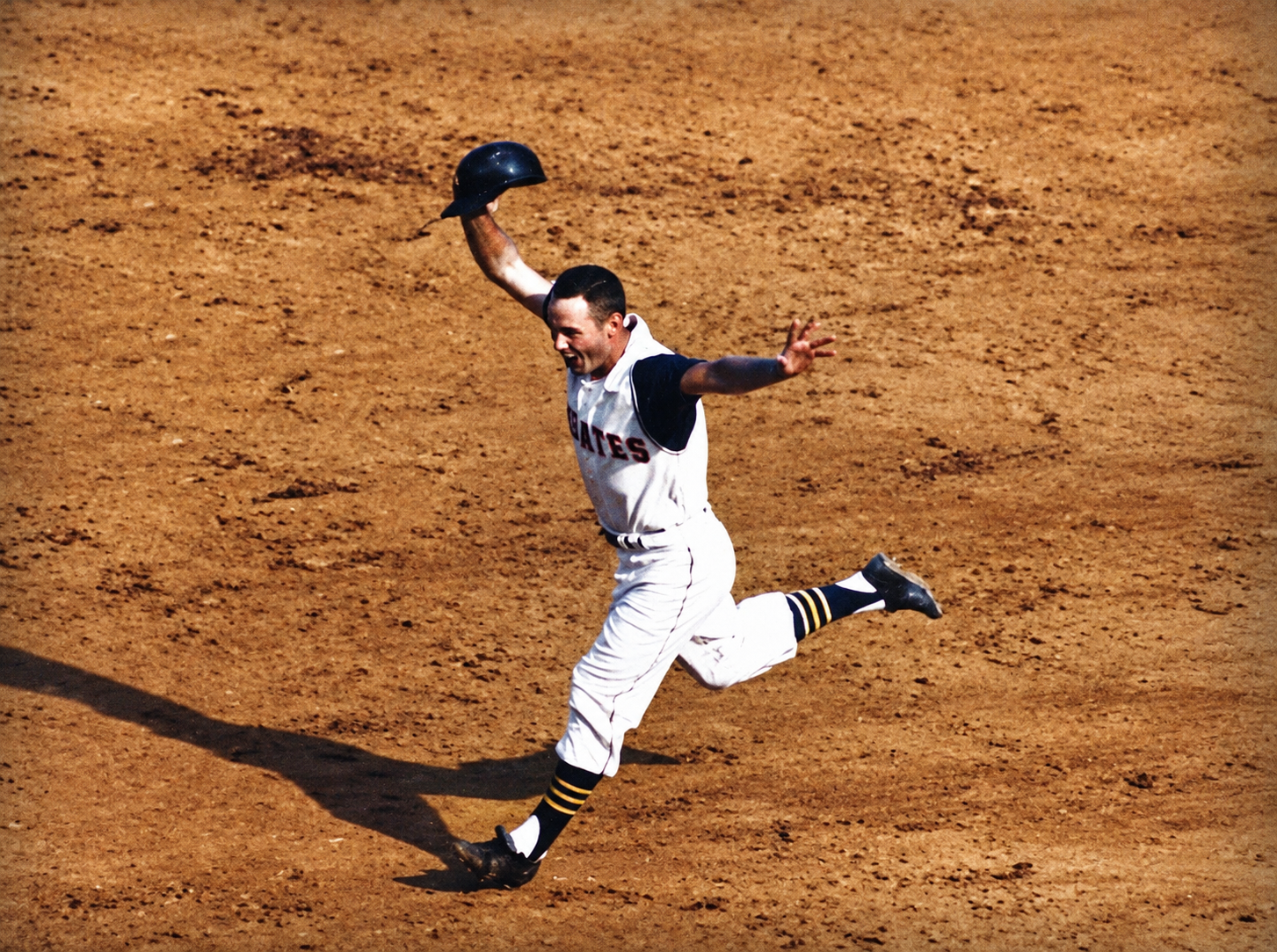
Mazeroski rounded first with his helmet raised, then raced around the bases as teammates poured from the dugout and spectators began spilling onto the field. The Yankees had scored more runs across the seven games. The Pirates had won four of them. That was the only arithmetic that mattered.
There had been World Series walk-off hits and extraordinary championship moments before. But never had a player ended the seventh game of a World Series with a home run. It remains one of the sport's singular images: a ball beyond the wall, a helmet held aloft, and an entire city losing itself in joy.
When Forbes Field Became Pittsburgh
The crowd rushed the diamond. Celebration spilled from the ballpark into the streets, through neighborhoods and across a city that had waited more than a generation. Horns blared, strangers embraced and Pittsburghers who had listened at work or watched at home shared the same impossible conclusion: the Pirates had beaten the Yankees.
It was not simply that a beloved team had won. It was the way the team had won: battered, doubted, repeatedly pushed toward the edge and somehow still standing. The Pirates' resilience mirrored the pride of the city that claimed them.
And for Mazeroski, who had made his reputation on routine excellence rather than spectacle, there was no rehearsed response. The moment belonged to him, but he could hardly have understood how many other lives it would touch.
The Swing Was the Beginning of the Legend, Not the Whole Career
Mazeroski continued playing for Pittsburgh through 1972, spending his entire 17-season major-league career in a Pirates uniform. He helped the club win another World Series in 1971. His record of 1,706 double plays turned as a second baseman speaks to a career built on consistency, positioning and teamwork.
When the Hall of Fame welcomed him in 2001, the honor recognized the full measure of his work at second base. The home run was unforgettable, but a lifetime of exceptional defense made him worthy of Cooperstown.
That distinction matters. The swing did not turn an ordinary player into a star. It turned an already great player into a symbol of Pittsburgh sports history.
A City That Still Knows the Next Pitch
Generations of Pirates fans have returned to the old Forbes Field site, replayed the broadcast and watched the grainy film of the final at-bat. They already know the count, the pitcher and the destination of the ball. They watch anyway.
They remember Smith's homer, Clemente's hustle, Groat's steady brilliance, Law's 20-win season, Murtaugh's calm and the thousands of smaller plays that made one championship swing possible. They remember a great team, not merely a spectacular ending.
Most of all, they remember that before Mazeroski lifted his helmet, he had earned the right to stand in that batter's box. He was already great. The Pirates were already great. And one swing gave their greatness a moment that could never be forgotten.
After the swing, he was a legend.
Forever.