

There are dates you remember because someone taught them to you. And there are dates you remember because something happened that made it impossible to forget.
For children growing up in western Pennsylvania, West Virginia and southeastern Ohio, those numbers are more than a date on a calendar. They mark the night something innocent and wonderful was taken from us. The night we discovered that loving something with your whole heart offered absolutely no protection against having it broken.
It was a Wednesday. A school night.
Some of us were sitting on living room carpets, close enough to the television to hear every word. Others were curled up on couches beside our fathers, wearing Pirates shirts that had been washed so many times the lettering was beginning to fade. Some had homework waiting in another room. Some had already been told they were staying up too late.
Nobody wanted to go to bed.
And for those of us who had grown up with Barry Bonds, Andy Van Slyke, Bobby Bonilla, Doug Drabek, Jay Bell, José Lind and Jim Leyland, the World Series wasn't some distant dream anymore.
It was right there.
We could almost touch it.
We had watched the Pirates win three consecutive National League East championships. We had endured the disappointment of 1990 against Cincinnati and the heartbreak of 1991 against Atlanta. We believed, with the unreasonable certainty that only children possess, that 1992 would finally be our year.
And for eight innings in Atlanta, it was.
Doug Drabek was magnificent. The Pirates had scored in the first inning and again in the sixth. They led the Braves 2–0 entering the bottom of the ninth inning of Game 7 of the National League Championship Series.
For a child born in the early 1980s, 1979 might as well have been ancient history. Willie Stargell and the We Are Family Pirates belonged to our parents' memories.
This was supposed to be ours.
Then the ninth inning began.
Terry Pendleton doubled. David Justice reached when Lind, ordinarily one of the surest fielders in baseball, couldn't handle a ground ball. Sid Bream walked, loading the bases with nobody out.
Jim Leyland came out to remove Drabek. Stan Belinda entered with the season balanced on every pitch.
Ron Gant hit a deep fly ball that Bonds caught near the left-field wall. Pendleton scored.
One out.
Damon Berryhill walked, and the bases were loaded again. There were pitches that looked like strikes, calls we couldn't understand, and a growing feeling that the whole world was somehow turning against us.
Then Belinda retired Brian Hunter on a pop-up.
Two outs.
One more out, and every horrible possibility would disappear. We would celebrate. We would wake up Thursday morning exhausted and happy. We would wear our Pirates shirts to school and talk about the World Series.
And then Francisco Cabrera walked to the plate.
Two Spanish words that an entire generation of Pittsburgh baseball fans would never, ever forget.
He was hardly the man anyone expected to decide the National League pennant. A reserve player with only 10 regular-season plate appearances that year, Cabrera had barely figured into the story.
Until suddenly, he became the story.
Belinda delivered.
Cabrera reached out and sent a sharp ground ball between third and short, into left field.
Justice scored.
Tie game.
But there was still Sid Bream, rounding third.
Sid Bream, of all people.
The former Pirate. The familiar face. The man who had once worn our uniform and who, with his damaged knees and cumbersome stride, seemed like the last runner in baseball who should have been able to score from second on that hit.
Bonds charged the ball in left field and threw home.
It was a tremendous effort, a one-hop throw that gave catcher Mike LaValliere a genuine chance to make the play. LaValliere received it slightly toward the first-base side of home plate and lunged back toward Bream.
For one impossible instant, the entire season existed in the space between a catcher's glove and a sliding runner.
Then home plate umpire Randy Marsh made the call.
Not a quiet word. Not a small, forgettable gesture.
We remember the emphatic motion of his arms, his whole body delivering the verdict as though the word itself needed to be driven into the ground.
Safe.
The Braves had won, 3–2.
Atlanta-Fulton County Stadium erupted. Players poured onto the field. The crowd of 51,975 became a roaring celebration of everything that had just been taken from Pittsburgh.
And somewhere hundreds of miles away, in living rooms across the Alleghenies, children stopped breathing for a moment.
It was over.
There would be no World Series.
There would be no parade.
There would be no happy ending.
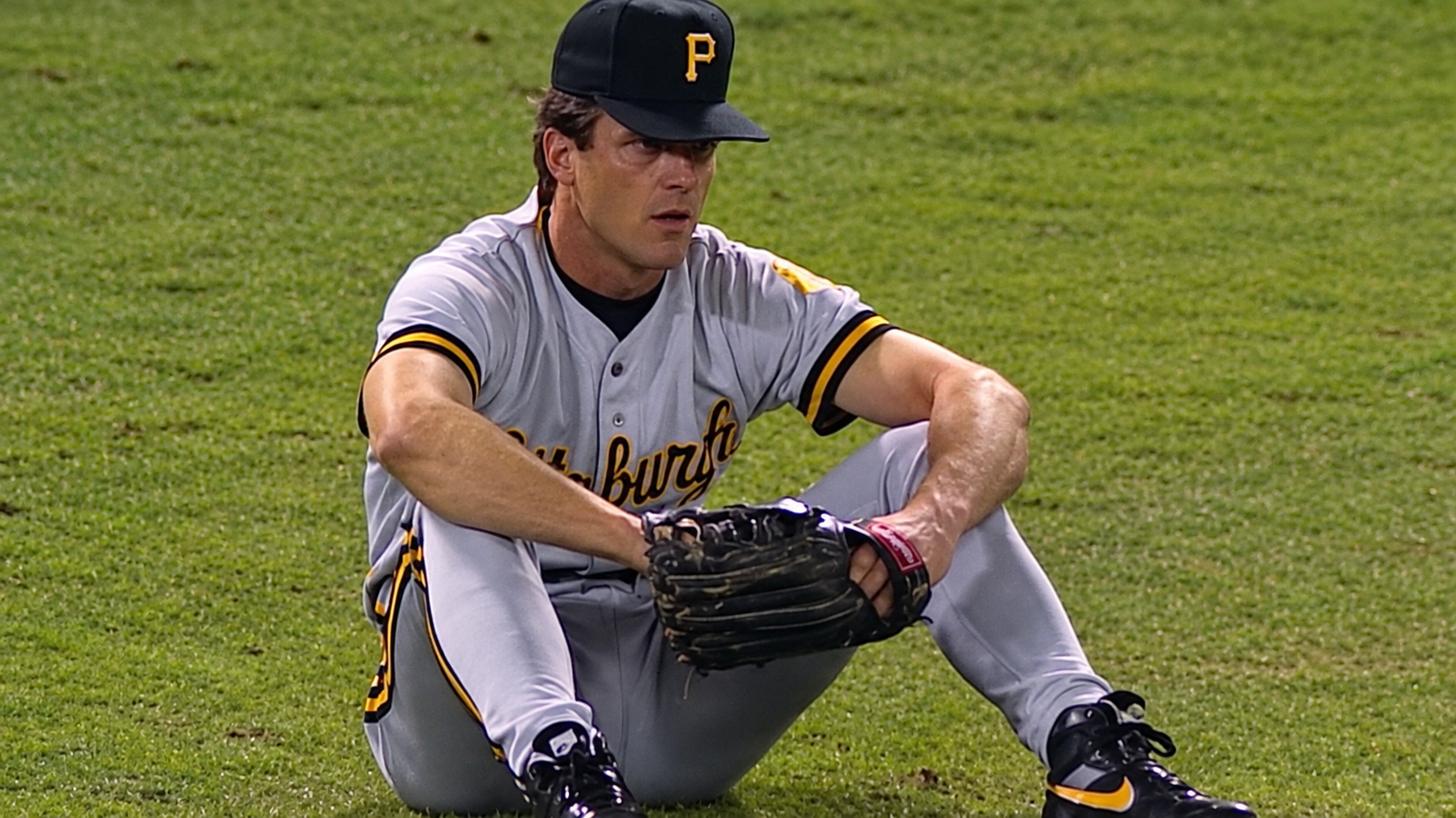
And then there was Andy Van Slyke.
Of everything that happened that night, of all the pictures that have remained lodged in our memories, perhaps none is more painful than the sight of our center fielder sitting alone in the outfield grass.
His hat sat crookedly atop his head. His elbows rested on his knees. His shoulders slumped beneath the weight of a season that had ended seconds earlier.
He wasn't arguing. He wasn't throwing equipment. He wasn't even walking toward the dugout.
He just sat there.
Motionless.
A grown man who had spent an entire summer chasing something extraordinary, suddenly looking as helpless and heartbroken as the children watching him on television.
We knew exactly how he felt.
And somehow, seeing him like that made everything worse.
Because Andy Van Slyke wasn't supposed to look defeated. He was supposed to be the smiling, diving, joking center fielder who made impossible catches and made baseball seem like the greatest game anyone had ever invented.
But there he was, sitting in the grass while another team celebrated.
And for the first time, maybe, we understood that even our heroes couldn't make everything right.
The television kept showing the celebration in Atlanta. Braves players embracing. Fans cheering. Sid Bream being swallowed by his teammates.
But in our homes, there was a different kind of silence.
Maybe a father shut off the television without saying anything. Maybe a mother tried to explain that there would be another season. Maybe somebody said the Pirates had played a great game and there was nothing to be ashamed of.
We knew they meant well.
But we didn't want another season.
We wanted this season.
We wanted these Pirates.
And we wanted the ending we had already imagined.
For some of us, the tears came immediately. For others, they never came at all. We simply stared at the screen, waiting for someone to explain how something that had seemed so certain could vanish in a few terrible seconds.
Not because a baseball game was truly the same as losing someone we loved, but because, at that age, we didn't yet have the words to describe grief on a smaller scale. We only knew that something precious had been there, and now it was gone.
And the worst part was that we couldn't fix it.
We couldn't ask for one more pitch. We couldn't rewind the ninth inning. We couldn't make José Lind field the ball cleanly or make the umpire raise his fist instead of spreading his arms.
We couldn't make Sid Bream out.
The following morning, the world behaved as though nothing had happened.
School buses arrived. Teachers handed out assignments. The sun came up over the hills of western Pennsylvania, West Virginia and southeastern Ohio.
But something had changed.
We went to school carrying a sadness that adults might have dismissed as disappointment over a game.
It wasn't just a game to us.
It was the summer we'd spent listening to announcers, studying box scores, collecting baseball cards and pretending to be our favorite players in backyards. It was the bond between fathers and sons, between friends, between entire communities that believed Pittsburgh could do something special.
It was childhood, with all its wonderful certainty that the good guys would eventually win.
And on October 14, 1992, that certainty disappeared.
We didn't know then that Bonds would leave Pittsburgh for San Francisco that winter, that Drabek would depart for Houston, or that the Pirates were about to begin a stretch of losing seasons that would last two decades.
We didn't know that this wasn't simply the end of a season.
Maybe that's why it still hurts.
Thirty-four years have passed. Those of us who were children have become parents, and some have become grandparents. We've lived through real tragedies, lost people we loved, celebrated marriages and births, and experienced all the things that put a baseball game into perspective.
And still, somehow, October 14 brings us back.
Back to the living room.
Back to the television.
Back to the ninth inning.
Back to Barry Bonds throwing home, Mike LaValliere reaching for the tag, Randy Marsh throwing his arms wide, and Andy Van Slyke sitting alone in center field.
Back to the night we learned that sometimes you can do almost everything right, come within one out of everything you've dreamed about, and still lose.
We remember Francisco Cabrera.
We remember Sid Bream.
We remember that terrible word.
And we remember how, for one generation of children who loved the Pittsburgh Pirates, a little piece of childhood ended on a Wednesday night in October.
Maybe the most heartbreaking thing of all is that, thirty-four years later, some part of us is still sitting beside Andy Van Slyke in that outfield grass.
Still waiting for the ending to change.
Still wishing we could have just one more out.